

Drug & Substance Guide
Valproate (Valproic Acid / Divalproex): Complete Guide to Uses, Dosage, Levels, Side Effects & Safety
Admissions answered 24 hours a day · Free and confidential
Excellent 4.6 out of 5 434 Google reviews across our locations



What clients say
Trusted by clients across Texas
4.6 from 434 Google reviews across 9 locations
Across Nova Recovery Center, Briarwood Detox Center and Eudaimonia Recovery Homes
★★★★★
“Nova is far from perfect, and some of the information can be misleading. But if you want to cover the 12 Steps while enjoying good food and a beautiful scenic view, this is the place for you. The…”
10 months ago · Wimberley
★★★★★
“I did 90 days at Nova Recovery 6 years ago. I am still sober today. And living a life I could have never imagined. The people and the program they are running impacted me for a lifetime. Better than…”
2 years ago · Wimberley
★★★★★
“I went to Nova almost 9 months ago and I wouldn’t change it for the world. The staff when I first entered were very nice and welcoming. As a 19 year old that didn’t know what I was getting myself…”
2 years ago · Austin
★★★★★
“Nova Recovery Center has been an invaluable part of my journey to sobriety. The intensive inpatient program, coupled with the unwavering support and guidance from my recovery specialist, Mark Rector…”
2 years ago · Austin


★★★★★
“I had such a positive experience at Nova Recovery in Wimberley! The staff genuinely cares and went above and beyond to support me every step of the way. The peaceful setting made it easier to focus…”
a year ago · Wimberley
★★★★★
“I love Nova so freaking much. Nova has saved my life in more ways than one. I was hopeless and had no solution suffering from this disease. The staff there never gave up on me. I was the worst client…”
2 years ago · Austin
★★★★★
“I know Mark rector is non-binary however it saved my life and it did a good job with CPR and I don't know how aside from staying sober I could ever repay it thank you Mr or Mrs or whatever you're…”
8 months ago · Austin
★★★★★
“It's been a few years since I was a patient at Nova Recovery Center. Recently I have been reflecting on my time there and how incredibly grateful I am for the experience I had. I have been to 7 rehab…”
2 years ago · Austin


Exceptional standards, backed by credible organizations
Our affiliations and accreditations



Medically Reviewed
Drug Information
Brand / names: Divalproex, Depakote
Drug class: Anticonvulsants and Antiseizure Medications
What valproate is
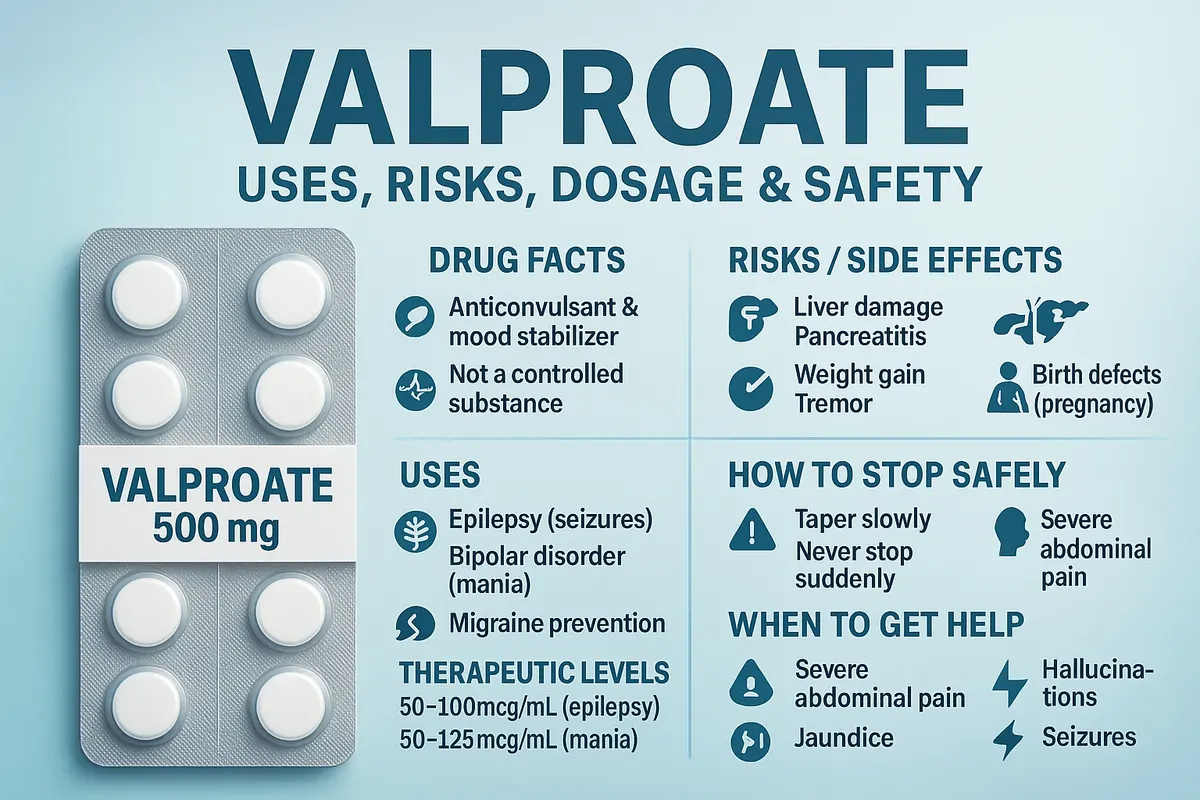
Valproate is an anticonvulsant and mood stabilizer, sold as valproic acid, sodium valproate or divalproex sodium, under brand names including Depakene, Depakote, Depakote ER and Depakote Sprinkle.
It treats epilepsy, the manic phase of bipolar disorder, and prevents migraines. It carries serious warnings: liver damage, pancreatitis, and birth defects if taken during pregnancy. The formulations are closely related but not automatically interchangeable, which matters when a prescription changes. This page covers the uses, the dosing and blood levels, the side effects and the safety rules.
- What it is
- An anticonvulsant and mood stabilizer
- What it treats
- Epilepsy, bipolar mania, migraine prevention
- Serious risks
- Liver damage, pancreatitis, birth defects
- Stopping it
- Never suddenly; supervised taper only
Valproate and pregnancy is the warning that matters most on this page. Raise it with a prescriber before anything else.

What is Valproate?
Valproate is a broad‑spectrum anti‑seizure and mood‑stabilizing medicine available as valproic acid, sodium valproate, and divalproex sodium (brand examples include Depakene®, Depakote®, Depakote ER®, and Depakote Sprinkle®). Despite name differences, these formulations are closely related; however, they are not automatically interchangeable and dosing differs by formulation.

What it treats (approved indications may vary by country):
- Epilepsy (various seizure types)
- Bipolar disorder (acute mania)
- Migraine prevention (not for acute migraine)
How it works (in brief): Valproate increases GABA availability and modulates voltage‑gated sodium channels; it also has histone deacetylase inhibitor activity. The net effect is reduced neuronal hyperexcitability.
About the Author

Mat Gorman
Mat Gorman is an experienced mental health writer and medical researcher with over a decade of experience in addiction recovery education. He specializes in translating complex clinical topics into clear, compassionate content that empowers families and individuals seeking treatment. Mat has collaborated with recovery centers, licensed therapists, and physicians to publish evidence-based resources across the behavioral health space. His passion for helping others began after witnessing the struggles of loved ones facing substance use disorder. He now uses his platform to promote hope, clarity, and long-term healing through accurate, stigma-free information.








Formulations, brand names & what each one means
- Valproic acid (VPA), often “Depakene®” in the U.S. (capsules, syrup).
- Divalproex sodium (DVPX) (“Depakote®” DR (delayed‑release) and ER (extended‑release), plus sprinkle capsules.
- Sodium valproate) commonly used brand names in the UK/EU (e.g., Epilim®).
Important: Products cannot be substituted 1:1. If switching, your prescriber adjusts dose/form.
Who can and cannot take Valproate
Valproate can be effective for many adults and children, but not everyone should take it.
Avoid / contraindicated or generally not preferred in:
- Pregnancy or those planning pregnancy (unless no suitable alternative; strict programs apply: see below).
- Liver disease or certain rare metabolic disorders (e.g., Alpers‑Huttenlocher, urea‑cycle disorders).
- History of pancreatitis.
Your clinician will review personal risks before prescribing.
High‑priority safety warnings (what to know before dosing)
- Pregnancy risksValproate can cause major birth defects (including neural tube defects) and neurodevelopmental problems; many countries require a Pregnancy Prevention Programme (PPP) for patients with child‑bearing potential. Do not stop suddenly; consult a specialist urgently if you become or plan to become pregnant.
- Liver toxicity (hepatotoxicity)Most likely within the first 6 months; highest risk in very young children and those on multiple anti‑seizure medications. Watch for fatigue, abdominal pain (right side), dark urine, jaundice.
- PancreatitisCan occur at any time; symptoms include severe abdominal pain radiating to the back, nausea, vomiting. Seek emergency care.
How to take Valproate (dosing, titration, ER vs DR vs sprinkle)

General principles (adults; individualized):
- Start low, titrate graduallytypical starting 10–15 mg/kg/day, increasing 5–10 mg/kg/week to effect.
Maximum recommended: 60 mg/kg/day (beyond which evidence is limited). - Divide doses unless using ER once dailyDR and sprinkle are typically given in divided doses.
- Do not crush DR/ER tablets; sprinkle beads can be opened on soft food and swallowed without chewing.

Examples:
- “Depakote ER dosing / initial dose”: Acute bipolar mania often starts 750 mg/day (divided) for DR, or ~25 mg/kg/dayonce daily for ER; titrate quickly to the lowest effective dose. Do not exceed 60 mg/kg/day.
- “Depakote 500 mg twice a day”A common divided regimen depending on clinical response and formulation; always individualize and monitor levels/response.
- “Loading dose / 2000 mg a day / max dose for seizures or bipolar”Some scenarios use higher initial loads (clinician‑directed). Across indications, the labeled ceiling remains ~60 mg/kg/day.
Never change dose or formulation (ER ↔ DR ↔ valproic acid syrup) without prescriber guidance; these are not automatically interchangeable.
Ready to take the next step?

Therapeutic drug monitoring (TDM): “Depakote levels”
Why monitor: To optimize control and reduce toxicity, especially when changing doses, adding interacting meds, or when side effects emerge.

Typical targets (total valproate):
- Epilepsy: 50–100 mcg/mL
- Mania (bipolar): 50–125 mcg/mL
- Free valproate (unbound) reference: ~5–25 mcg/mL
Timing is usually trough (right before next dose). Your lab and clinician set targets based on your situation.
Note: Clinical response does not always correlate perfectly with a number. Some patients respond below or above the “typical” range under careful supervision.
Common side effects & how to manage them
We accept most major insurance
Most major insurance covers treatment here
We'll check your benefits for free and tell you what you'd actually pay, before you commit to anything.
















Takes about 2 minutes · No obligation · Or call (512) 605-2955
Don't see yours? We work with more plans than we can show here.
VERIFY YOUR INSURANCE | 100% CONFIDENTIAL

Pregnancy, breastfeeding & fertility
- PregnancyValproate must be avoided in pregnancy for migraine and bipolar when alternatives exist, and generally avoided in epilepsy unless no suitable alternative controls seizures. PPP requirements apply in many regions (e.g., UK/EU). Do not stop suddenly, consult a specialist urgently.
- Men / people who can father childrenRecent MHRA guidance includes precautionary contraception advice for men on valproate (based on emerging neurodevelopmental signal). Policies have been refined in 2025 regarding when “two‑clinician reviews” are needed (primarily at initiation for men <55).
- BreastfeedingSmall amounts pass into milk; discuss risks/benefits with your clinician. (See patient monographs for details.)

Drug interactions
- Lamotrigine + ValproateValproate can increase lamotrigine levels and raise serious rash risk (including SJS/TEN). Clinicians use slower lamotrigine titration and close monitoring.
- Carbapenem antibiotics (e.g., meropenem)Can drastically lower valproate levels (50–90% within days); co‑use is not recommended; seek alternatives.
- Aspirin and protein‑binding interactionsMay increase the free (active) fraction of valproate, monitoring may be needed (clinician‑directed).
- Always share all prescription/OTC drugs and supplements with your prescriber before changes.

Special populations & nursing considerations
Children <2 years and those on multiple anti‑seizure drugs have higher hepatotoxicity risk, specialist care and close monitoring are essential.
Hepatic impairment: Typically contraindicated or requires extreme caution.
Renal impairment: No routine dose change, but monitor closely for adverse effects.
Nursing considerations (popular query in your list):
Verify formulation (ER vs DR vs syrup vs sprinkle) and dosing schedule.
Confirm indication (seizures vs bipolar vs migraine prevention).
Educate on boxed warnings and pregnancy program requirements.
Ensure baseline and periodic labs (LFTs; consider levels).
Watch for GI symptoms, sedation, tremor, and rash especially if combined with lamotrigine.
Reinforce adherence; warn against abrupt discontinuation.
Freedom Starts Here. Take Back Your Life Today.
Same-Day Admissions in Austin Available.

Practical tips: adherence, missed doses, storage, alcohol
- Missed doseTake when remembered unless near the next dose, then skip; never double up.
- StorageRoom temperature, dry place; keep away from children.
- AlcoholCan increase sedation. Ask your clinician about your situation.
Frequently Searched Valproate (Depakote / Divalproex) Subtopics: Dosage, Blood Levels, Side Effects, and Safety Questions

How Nova Recovery Center Can Help with Valproate Addiction and Abuse
At Nova Recovery Center, we understand that misuse or long-term dependence on Valproate (valproic acid, divalproex, Depakote) can create serious challenges for both physical and mental health. Our team provides comprehensive medical and therapeutic support to help individuals safely detox from prescription medications under close supervision. We recognize the unique risks associated with Valproate use, including withdrawal concerns, mood instability, and medical complications, and we create personalized treatment plans to address each client’s needs. With evidence-based therapies, structured recovery programming, and holistic care, we guide clients through the recovery process while focusing on relapse prevention. Our programs emphasize accountability, peer support, and skill development to promote long-term stability beyond treatment. For those struggling with co-occurring conditions such as bipolar disorder or seizure disorders, our clinicians collaborate to ensure safe medication management and continuity of care. At Nova, recovery extends beyond detox. We provide a full continuum of care including residential treatment, intensive outpatient programs, and sober living. This integrated approach helps individuals rebuild their lives free from the cycle of prescription drug abuse.
Get help today. Reach out now to start your path to healing.
Sources
- Indications & patient use: MedlinePlus, Mayo Clinic.
- Boxed warnings & dosing maxima: FDA labels (Depakote/Depakene).
- Therapeutic ranges: StatPearls; lab references.
- Pregnancy risk & PPP: MHRA/EMA/NICE pages.
- Interactions: Lamotrigine rash risk and carbapenem reductions.
- NHS structure/UX cues for consumer comprehension.
Other Outpatient Drug and Alcohol Rehab Locations
- IOP in Austin
- IOP in San Antonio
- IOP in Colorado Springs

Medical Disclaimer
The information on this page is provided for educational purposes only and should not be used as a substitute for professional medical advice, diagnosis, or treatment. Valproate (valproic acid, divalproex, Depakote) and other prescription medications must only be taken under the supervision of a licensed healthcare provider. Do not start, stop, or adjust your dosage without consulting your doctor. If you experience severe side effects, withdrawal symptoms, or thoughts of self-harm, call 911 immediately if you are in the United States, or seek urgent medical care. For mental health support, you can also dial 988 to connect with the Suicide & Crisis Lifeline, available 24/7.

Nova Recovery Center Editorial Guidelines
By instituting a policy, we create a standardized approach to how we create, verify, and distribute all content and resources we produce. An editorial policy helps us ensure that any material our writing and clinical team create, both online and in print, meets or exceeds our standards of integrity and accuracy. Our goal is to demonstrate our commitment to education and patient support by creating valuable resources within our realm of expertise, verifying them for accuracy, and providing relevant, respectful, and insightful data to our clients and families.
Keep reading
- Anticonvulsants (Antiseizure Medications): Uses, Types, Risks & Safety
- Naproxen: Uses, Dosage, Side Effects, Interactions & Safety
- Lithium (Lithium Carbonate): Uses, Dosage, Levels, Side Effects & Interactions
- Carbamazepine/Oxcarbazepine: Uses, Differences, Side Effects, Interactions & Safety
- Disulfiram for Alcohol Addiction: How It Works Safely
Talk to someone today
Ready when you are
Admissions are answered 24 hours a day by a person, not a queue. We will check your benefits for free and tell you what treatment would actually cost.
Free and confidential · No obligation