
Drug & Substance Guide
Ketorolac (Toradol): Uses, Dosage, Side Effects, Interactions & Safety
Admissions answered 24 hours a day · Free and confidential
Excellent 4.6 out of 5 434 Google reviews across our locations



What clients say
Trusted by clients across Texas
4.6 from 434 Google reviews across 9 locations
Across Nova Recovery Center, Briarwood Detox Center and Eudaimonia Recovery Homes
★★★★★
“Nova is far from perfect, and some of the information can be misleading. But if you want to cover the 12 Steps while enjoying good food and a beautiful scenic view, this is the place for you. The…”
10 months ago · Wimberley
★★★★★
“I did 90 days at Nova Recovery 6 years ago. I am still sober today. And living a life I could have never imagined. The people and the program they are running impacted me for a lifetime. Better than…”
2 years ago · Wimberley
★★★★★
“I went to Nova almost 9 months ago and I wouldn’t change it for the world. The staff when I first entered were very nice and welcoming. As a 19 year old that didn’t know what I was getting myself…”
2 years ago · Austin
★★★★★
“Nova Recovery Center has been an invaluable part of my journey to sobriety. The intensive inpatient program, coupled with the unwavering support and guidance from my recovery specialist, Mark Rector…”
2 years ago · Austin


★★★★★
“I had such a positive experience at Nova Recovery in Wimberley! The staff genuinely cares and went above and beyond to support me every step of the way. The peaceful setting made it easier to focus…”
a year ago · Wimberley
★★★★★
“I love Nova so freaking much. Nova has saved my life in more ways than one. I was hopeless and had no solution suffering from this disease. The staff there never gave up on me. I was the worst client…”
2 years ago · Austin
★★★★★
“I know Mark rector is non-binary however it saved my life and it did a good job with CPR and I don't know how aside from staying sober I could ever repay it thank you Mr or Mrs or whatever you're…”
8 months ago · Austin
★★★★★
“It's been a few years since I was a patient at Nova Recovery Center. Recently I have been reflecting on my time there and how incredibly grateful I am for the experience I had. I have been to 7 rehab…”
2 years ago · Austin


Exceptional standards, backed by credible organizations
Our affiliations and accreditations




Ketorolac Overview at a Glance
What drugs interact with ketorolac?
What drugs interact with ketorolac: Other NSAIDs, aspirin, anticoagulants, SSRIs/SNRIs, ACE inhibitors/ARBs, diuretics, lithium, methotrexate, cyclosporine, and digoxin.
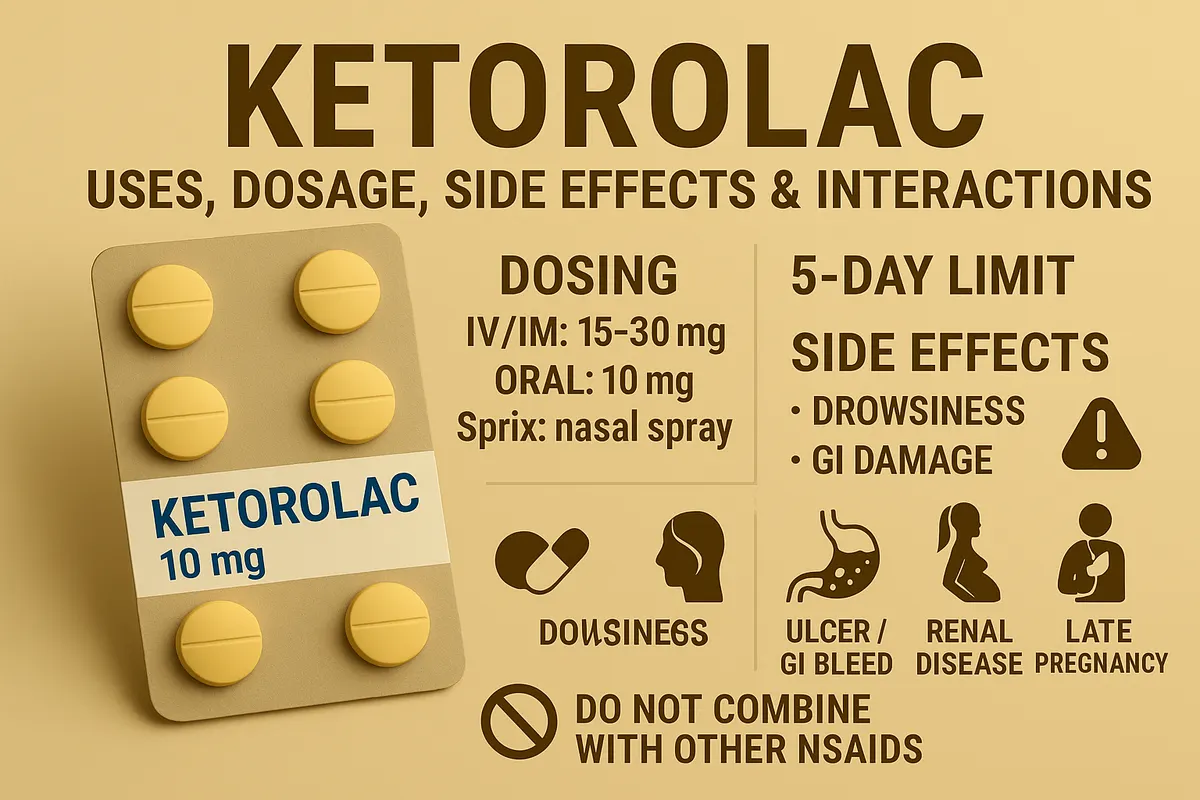
Ketorolac, also known as ketorolac tromethamine and sold under brand names like Toradol (injection/tablet) and Sprix (nasal spray), is a prescription NSAID analgesic used for short‑term relief of moderate to moderately severe acute pain, most often after surgery or injury. It is not an opioid and is not habit‑forming, but it does carry important boxed warnings for gastrointestinal (GI), kidney, and cardiovascular (CV) risks. Critically, treatment must not exceed 5 days in adults, across all routes combined. Mayo Clinic+2MedlinePlus+2
Bottom line up front: Ketorolac can be very effective for short‑term pain after procedures, but safety depends on using the correct route, dose, and duration, and avoiding dangerous drug combinations. If you’re older, under 110 lbs (50 kg), or have kidney issues, your dose should be lower.





What ketorolac is, and what it is not
Ketorolac, sold as Toradol, is a nonsteroidal anti-inflammatory painkiller for moderate to severe acute pain, usually after surgery or injury.
It is not an opioid. It also carries a hard limit of five days in total across every form, because its serious risks include stomach bleeding, kidney problems and cardiovascular events. This page covers its uses, dosage, side effects, interactions and who should not take it.
- How it works
- Blocks COX-1 and COX-2
- Is it a narcotic
- No
- Why it matters here
- It spares opioids after surgery
- Not for
- Chronic pain
Opioid-sparing pain control after surgery matters most to people in recovery. Tell your surgical team you are in it.
Common scenarios: pain after orthopedic procedures, abdominal surgery, dental surgery, or emergency‑department treatment of acute pain. (Some clinicians use it off‑label for migraine or dental pain, but that’s outside FDA labeling.)
Who ketorolac is for, and who should avoid it
Appropriate use: Adults who need short‑term, opioid‑level analgesia following surgery or an acute injury. Therapy typically starts with IV or IM dosing in a monitored setting; oral ketorolac may be used only as continuation if necessary. Sprix provides a non‑injection option for certain adults.
Do not use if any of the following apply:
Active peptic ulcer disease, recent GI bleed or perforation, or a history of NSAID‑related ulcers/bleeding.
CABG surgery context (perioperative pain).
Advanced renal impairment or volume depletion.
Labor and delivery (contraindicated, can affect fetal circulation/uterine contractions).
Aspirin‑sensitive asthma or serious hypersensitivity to ketorolac/NSAIDs.
Concurrent aspirin or other NSAIDs (cumulative risk).
MedlinePlus also notes ketorolac injection is used in people ≥17 years and stresses the 5‑day maximum.
Dosing & administration (all routes)
Never exceed 5 days total (all forms combined). Dose reductions are required in older adults (≥65), <50 kg body weight, and renal impairment.
V / IM (injection)
Typical adult dosing (single dose):
IM: 60 mg once (if <65 years, ≥50 kg, normal renal function); 30 mg once (if ≥65 years, <50 kg, or renal impairment).
IV: 30 mg once (if <65 years, ≥50 kg, normal renal function); 15 mg once (if ≥65 years, <50 kg, or renal impairment).
Multiple‑dose treatment:
- <65 years, ≥50 kg30 mg IV/IM every 6 hours as needed (max 120 mg/day) for the injectable portion.
- ≥65 years or <50 kg or renal impairment15 mg IV/IM q6h (max 60 mg/day).
Side effects

Common (often mild/transient)
Nausea, dyspepsia, abdominal pain
Dizziness, drowsiness (avoid driving/heavy machinery until you know your reaction)
Headache
Edema (swelling), increased blood pressure

Serious. Stop and get medical help
- GI bleeding or ulcerblack tarry stools, vomiting blood/coffee‑ground material, severe persistent stomach pain.
- Kidney problemsreduced urination, sudden weight gain or swelling of legs/feet, fatigue.
- Cardiovascular eventschest pain, shortness of breath, unilateral weakness/slurred speech.
- Severe skin/allergic reactionshives, wheeze, facial swelling, blistering rash.
- Bleeding concernsunusual bruising; nosebleeds; bleeding that won’t stop.
We accept most major insurance
Most major insurance covers treatment here
We'll check your benefits for free and tell you what you'd actually pay, before you commit to anything.
















Takes about 2 minutes · No obligation · Or call (512) 605-2955
Don't see yours? We work with more plans than we can show here.
VERIFY YOUR INSURANCE | 100% CONFIDENTIAL
Warnings & contraindications (what makes ketorolac risky)

High‑concern interactions (groups & examples):
- Anticoagulants / Antiplateletswarfarin, DOACs (apixaban, rivaroxaban), heparins; clopidogrel, prasugrel, ticagrelor → major bleeding risk. Medscape Reference
- SSRIs/SNRIssertraline, fluoxetine, duloxetine, venlafaxine → increased GI bleed risk.
- ACE inhibitors / ARBs / Diureticslisinopril, losartan, HCTZ, furosemide → reduced kidney perfusion; monitor renal function.
- Lithium:NSAIDs reduce renal lithium clearance → lithium toxicity; avoid or monitor closely.
- Methotrexatedecreased renal clearance → toxicity.
- Cyclosporineadditive nephrotoxicity.
- Digoxinpotential increased levels; monitor if combined.
Always give your care team a complete medication list, including OTC pain relievers and supplements.
Special populations
Freedom Starts Here. Take Back Your Life Today.
Same-Day Admissions in Austin Available.
Comparisons: ketorolac vs. other pain relievers

Ketorolac vs. ibuprofen/naproxen
Ketorolac is typically more potent for short‑term postoperative pain than standard OTC doses of ibuprofen/naproxen, but it carries higher GI/renal risk and a strict 5‑day maximum. It’s a bridge medication, not a long‑term NSAID.
Ketorolac vs. celecoxib: Ketorolac is a non-selective NSAID for short-term, potent pain relief with a strict 5-day limit, while celecoxib (Celebrex) is a COX-2-selective NSAID often used for longer-term arthritis pain with a lower GI-bleeding risk.
Ketorolac vs. Robaxin: Ketorolac is an NSAID that targets pain and inflammation, while Robaxin (methocarbamol), a muscle relaxant, works differently to relieve muscle spasms, the two are sometimes used together under medical guidance.

Ketorolac and opioids
When used appropriately, ketorolac reduces opioid requirements after surgery (an “opioid‑sparing” effect). This can mean shorter recovery times and fewer opioid side effects.

Practical tips for safer use
- Know your limitMark your calendar, 5 days max from the first dose of any form (injection, oral, or nasal). Drugs.com
- Hydrate and eatTake oral doses with food and stay hydrated (helps reduce GI and renal strain).
- No double NSAIDsIbuprofen, naproxen, diclofenac, celecoxib, aspirin for pain, all off‑limits while on ketorolac. Read OTC labels.
- Alcohol cautionAlcohol + NSAIDs = higher GI bleed risk; avoid or minimize during the course.
- Watch for red flagsBlack/tarry bowel movements, vomiting blood, severe stomach pain, scant urine, shortness of breath, chest pain: seek urgent care.
- Sprix usersKeep track of sprays; discard the bottle 24 hours after first use, even if liquid remains.
- DrivingUntil you know how you respond (drowsy/dizzy), don’t drive or use machinery.
Friendly reminder: This page is educational and not medical advice. Always follow your prescriber’s directions and your local hospital’s protocols.
Frequently Asked Questions About Ketorolac (Toradol, Sprix, 10 mg Oral & Injection)
Is ketorolac a strong painkiller?
Yes. Ketorolac is considered a potent NSAID pain reliever, often used for short-term relief of moderate to severe pain, especially after surgery.
Is ketorolac the same as Toradol?
Yes. Toradol is the brand name for ketorolac tromethamine, available in injection and oral tablet form.
Is ketorolac as strong as hydrocodone?
Ketorolac can provide pain relief similar to some opioid medications, but it works differently and is not an opioid.
Is ketorolac 10 mg a narcotic?
No. Ketorolac is not a narcotic or opioid. It belongs to the nonsteroidal anti-inflammatory drug (NSAID) class.
How strong a painkiller is Toradol?
Toradol is one of the strongest NSAID analgesics available, often used in hospitals for short-term pain control.
Is Toradol stronger than Tramadol?
In many cases, Toradol provides faster and more potent pain relief than tramadol, but it carries different risks and strict duration limits.
Is Toradol just strong ibuprofen?
While both are NSAIDs, Toradol (ketorolac) is significantly stronger and comes with higher risks, which is why it’s limited to 5 days of use.
Is Toradol a controlled substance?
No. Toradol is not a controlled substance. It requires a prescription but is not classified as addictive.
What is Sprix used for?
Sprix is a nasal spray formulation of ketorolac, prescribed for short-term treatment of moderate to severe acute pain in adults.
Is Sprix an opioid?
No. Sprix (ketorolac nasal spray) is not an opioid, it’s an NSAID, just like injectable or oral ketorolac.

You Can Recover: Let’s Begin
Barbiturate addiction doesn’t define you. At Nova Recovery Center, we support individuals at every stage of the journey. We offer:
Get help today. Reach out now to start your path to healing.
Discover More About NSAIDs
Everything You Need to Know...
Other Outpatient Drug and Alcohol Rehab Locations
Keep reading
- Celecoxib (Celebrex, Elyxyb): Uses, Dosage, Side Effects & Interactions
- Naproxen: Uses, Dosage, Side Effects, Interactions & Safety
- Diclofenac: Uses, Dosage, Side Effects, Warnings & Interactions
- Ibuprofen (Advil, Motrin): Uses, Dosage, Side Effects, Interactions & Safety Guide
- Lithium (Lithium Carbonate): Uses, Dosage, Levels, Side Effects & Interactions
Talk to someone today
Ready when you are
Admissions are answered 24 hours a day by a person, not a queue. We will check your benefits for free and tell you what treatment would actually cost.
Free and confidential · No obligation